How to Choose the Right Sausage Filler | Buying Guide
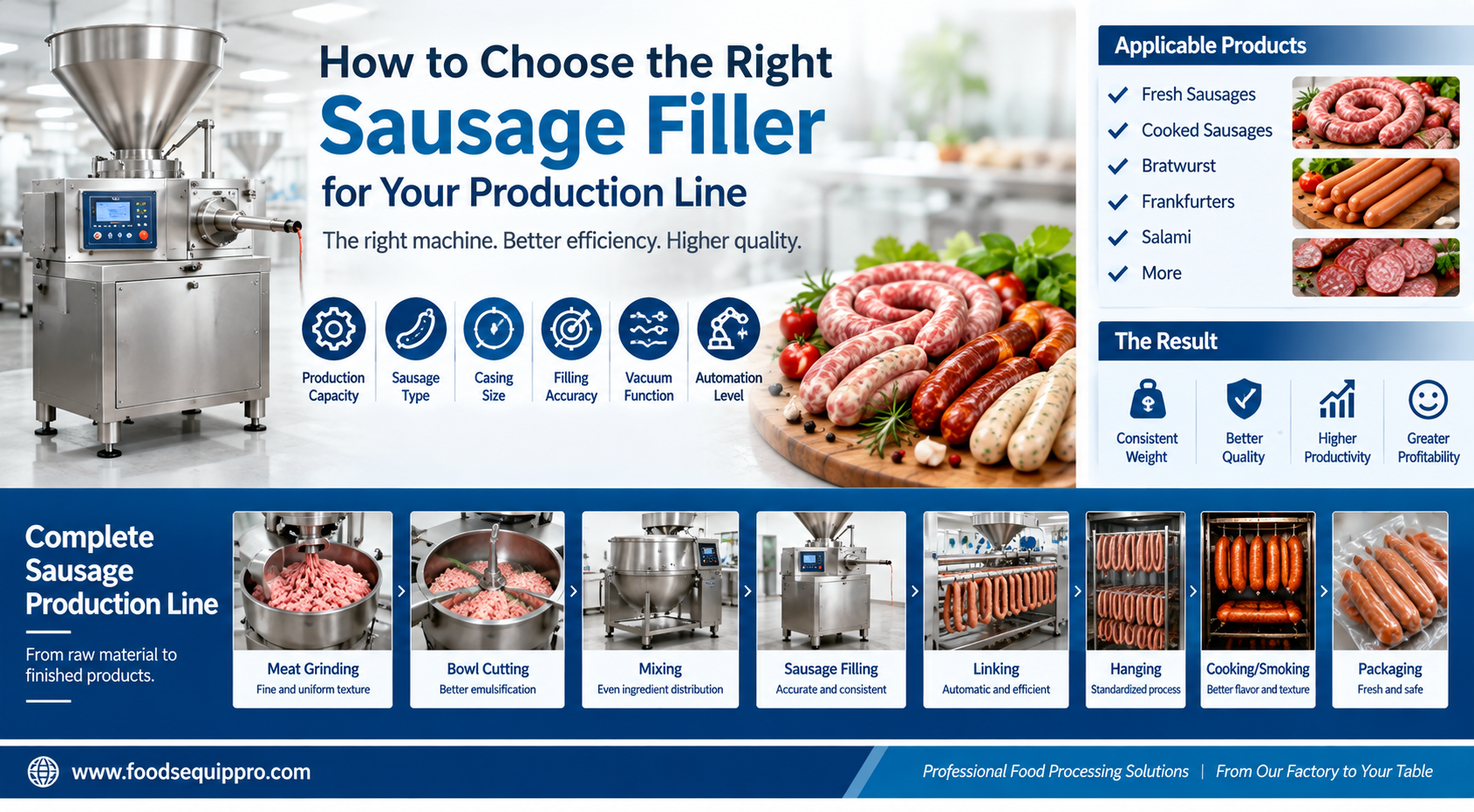
How to Choose the Right Sausage Filler for Your Production Line
Choosing the right sausage filler is an important decision for sausage manufacturers, meat processors, butcher shops, and food production facilities.
The right sausage filling machine can help improve production efficiency, filling consistency, portion control, and overall production flow.
However, choosing a sausage filler is not simply about selecting the machine with the highest capacity. Production volume, sausage type, casing size, filling accuracy, product characteristics, and automation requirements should all be considered.
What Is a Sausage Filler?
A sausage filler, also commonly called a sausage stuffer, is a food processing machine designed to fill prepared sausage mixtures into natural, collagen, or synthetic casings.
Depending on the machine configuration, sausage fillers can be used for fresh sausages, cooked sausages, bratwurst, frankfurters, salami, and other stuffed meat products.
For commercial production, an industrial sausage filler can also be integrated with sausage linking, hanging, and packaging equipment.
1. Consider Your Production Capacity
The first step is to determine how much sausage you need to produce.
Consider:
- Target production per hour
- Daily production volume
- Batch size
- Number of production shifts
- Expected future production growth
A small sausage producer may need a compact filling machine, while a large meat processing plant may require a high-capacity industrial or vacuum sausage filler.
Choosing capacity based only on the machine's maximum specification can lead to an unsuitable production setup.
2. Consider Your Sausage Products
Different sausage products may require different filling configurations.
Before choosing a sausage filler, identify:
- Sausage type
- Product formulation
- Sausage diameter
- Product weight
- Casing material
- Fresh or cooked product
- Required filling speed
For example, a manufacturer producing several sausage sizes may need a more flexible filling system than a producer specializing in one standard product.
3. Check Casing Size Compatibility
Casing size is another important factor.
The filling nozzle and filling system should be compatible with the casing diameter used in your production.
Common casing types include:
- Natural casings
- Collagen casings
- Synthetic casings
If you produce multiple sausage diameters, ask the equipment supplier about available nozzle and filling configurations.
4. Filling Accuracy and Portion Control
Consistent filling is important for both product appearance and weight control.
An appropriate sausage filler should provide stable product feeding and repeatable portioning.
Consistent filling can help reduce unnecessary variation between sausage portions and make downstream processing easier.
5. Consider Vacuum Filling
A vacuum sausage filler uses vacuum technology during the filling process to help reduce unwanted air in the sausage mixture.
Vacuum filling can be useful when processors are looking for:
- More consistent filling
- Reduced air pockets
- Stable product flow
- Improved product appearance
- Integration with automated sausage production
Whether vacuum filling is appropriate depends on the product and production process.
6. Consider Automation
For growing meat processing businesses, automation should also be considered.
A sausage filler can potentially be integrated with:
- Sausage linking machines
- Automatic sausage hanging machines
- Conveyors
- Cooking equipment
- Packaging equipment
A well-designed production line can reduce manual handling and create a more continuous workflow.
7. Consider the Complete Production Process
A sausage filler is only one part of the production line.
A typical sausage production process may include:
Meat Grinding → Bowl Cutting → Mixing → Sausage Filling → Linking → Hanging → Cooking/Smoking → Packaging
For example, your upstream process can use a 330L Meat Bowl Cutter or 200L Bowl Cutter for cutting and emulsifying meat mixtures before filling.
The final equipment configuration should be based on the complete production process rather than one machine alone.
FAQ
What is the difference between a sausage filler and a sausage stuffer?
In many English-speaking markets, "sausage filler" and "sausage stuffer" are used to describe equipment that fills sausage mixture into casings.
How do I choose the right sausage filler capacity?
Start with your target hourly output, daily production volume, batch size, product type, and future production requirements.
Is a vacuum sausage filler suitable for industrial production?
Vacuum sausage fillers can be used for commercial and industrial sausage production when the machine capacity and configuration match the production requirements.
Can one sausage filler handle different sausage sizes?
Depending on the machine configuration, different casing sizes and filling nozzles may be available.
Can a sausage filler be integrated with a sausage linking machine?
Yes. Suitable industrial filling systems can be configured to work with downstream linking and hanging equipment.
Conclusion
Choosing the right sausage filler requires more than comparing machine capacity.
Production volume, sausage type, casing size, filling accuracy, vacuum requirements, automation, and future production plans should all be considered.
A properly selected sausage filling machine can become an important part of an efficient and scalable meat processing line.
Looking for the right sausage filling solution?
Contact our team with your sausage type, casing size, target production capacity, and product requirements. We can help you identify a suitable sausage filling configuration for your production line.

