Hydraulic vs Vacuum Sausage Filler | Key Differences
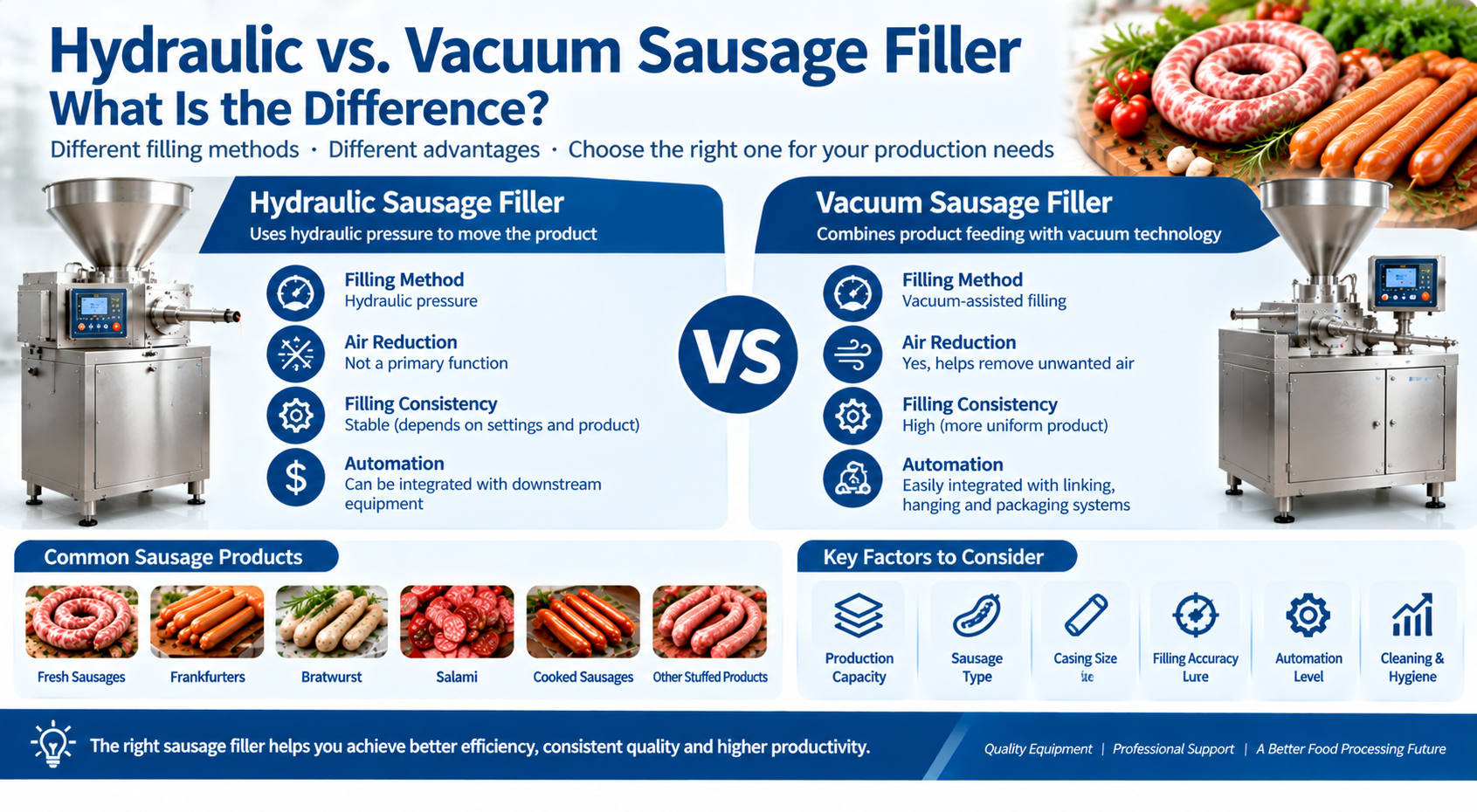
Hydraulic vs. Vacuum Sausage Filler: What Is the Difference?
Hydraulic and vacuum sausage fillers are both used in meat processing to fill sausage mixtures into casings.
Although they perform a similar basic function, their filling systems are different.
Understanding the difference between hydraulic and vacuum sausage fillers can help meat processors choose equipment based on production capacity, product characteristics, filling consistency, and automation requirements.
What Is a Hydraulic Sausage Filler?
A hydraulic sausage filler uses hydraulic pressure to move sausage mixture from the hopper toward the filling nozzle.
The hydraulic system generates the pressure required to transfer the product into the casing.
Hydraulic filling machines can be used for various sausage products depending on the machine configuration.
What Is a Vacuum Sausage Filler?
A vacuum sausage filler combines product feeding with vacuum technology.
During filling, the machine creates a vacuum around the product to help reduce unwanted air before the sausage mixture enters the casing.
Vacuum fillers are commonly considered for commercial and industrial sausage production where controlled filling and reduced air are important.
Hydraulic vs. Vacuum Sausage Filler
Filling Method
The main difference is the way the product is handled during filling.
A hydraulic filler primarily uses hydraulic pressure.
A vacuum filler combines product feeding with vacuum processing.
Air Reduction
A hydraulic filling system is not primarily designed around vacuum processing.
A vacuum filler is specifically designed to reduce unwanted air during the filling process.
Filling Consistency
Both systems can provide controlled filling when properly configured.
Actual filling consistency depends on product formulation, casing, machine settings, and operating conditions.
Automation
Both hydraulic and vacuum filling systems can be used in commercial production.
For highly automated sausage lines, the filler should be selected based on compatibility with downstream equipment such as sausage linkers and hanging machines.
Which Products Can Be Processed?
Depending on the machine configuration, sausage fillers can be used for:
- Fresh sausages
- Bratwurst
- Frankfurters
- Cooked sausages
- Salami
- Other stuffed meat products
The appropriate machine should be selected according to product characteristics and casing requirements.
Hydraulic Sausage Filler: When Should You Consider It?
A hydraulic filler may be considered when:
- Vacuum processing is not required
- The product is suitable for hydraulic filling
- The production volume matches the machine
- The operation does not require advanced vacuum filling
- A specific hydraulic configuration fits the production process
Vacuum Sausage Filler: When Should You Consider It?
A vacuum filler may be considered when:
- Reducing unwanted air is important
- Consistent product flow is required
- Commercial production is increasing
- Integration with automated equipment is needed
- The product benefits from vacuum filling
How to Choose Between Hydraulic and Vacuum Filling
There is no single configuration suitable for every meat processor.
Consider the following:
1. Product Type
Identify the exact sausage products you manufacture.
2. Casing
Provide casing material and diameter.
3. Production Capacity
Define your target output in kg/hour or units/hour.
4. Filling Requirements
Determine whether vacuum filling is required.
5. Automation
Consider whether the filler will connect to a linker, hanging machine, conveyor, or packaging system.
6. Future Production
Consider expected production growth when selecting machine capacity.
FAQ
Is a vacuum sausage filler better than a hydraulic filler?
The appropriate choice depends on the product, production requirements, desired filling process, and automation level.
What is the main advantage of vacuum filling?
Vacuum filling can help reduce unwanted air during the filling process.
Are hydraulic sausage fillers suitable for commercial production?
Yes. Hydraulic filling systems can be used for commercial meat production when the machine configuration matches the production requirements.
Can both types handle different sausage sizes?
Depending on the machine configuration, different filling nozzles and components can be used for different casing sizes.
Which machine should a large meat processing plant choose?
The choice should be based on production capacity, product characteristics, casing requirements, filling method, and automation plans.
Conclusion
Hydraulic and vacuum sausage fillers are both important types of sausage filling equipment.
The main difference is that vacuum fillers combine filling with vacuum processing to help reduce unwanted air.
Rather than choosing a machine based only on technology type, meat processors should evaluate the complete production process, product characteristics, casing, capacity, and automation requirements.
Need help comparing sausage filling options?
Send us your product type, casing diameter, target capacity, and production requirements. Our team can recommend a suitable sausage filling solution.

